Truly heavenly Gorgonzola!
Tosi is the only remaining Gorgonzola DOP producer that still makes the cheese by hand. Its state-of-the-art manufacturing facility in Lombardy makes cheesemaking smooth and helps guarantee consistent, high quality.
CHEESE PRODUCTION STARTS ON THE FARM
Tosi receives 10,000 liters of cow's milk from nearby farms every morning and evening. Each batch of milk is tested for antibiotics - if even a small amount of antibiotics is present in the milk, Tosi will not accept the milk. Close, trusting and cooperative relationships with dairy farmers are vital. Gorgonzola's DOP rules determine what living conditions the animals must have and what they are allowed to eat. The better the life the cows have, the better the milk they produce.

Animal welfare first - the better the life cows have, the better quality milk they produce
GENTLE AT EVERY TURN
It takes 100 liters of whole milk to make one 12-kilogram wheel of cheese - that's the milk produced by about four cows a day. The milk is pasteurized, then poured into a huge steel vat, where the cheesemaker adds rennet and microbial cultures that start the fermentation process. Just half an hour later, the milk has started to curdle, at which point it is cut twice: first with a long sabre, and then with a scraper, which rounds and softens the curd.
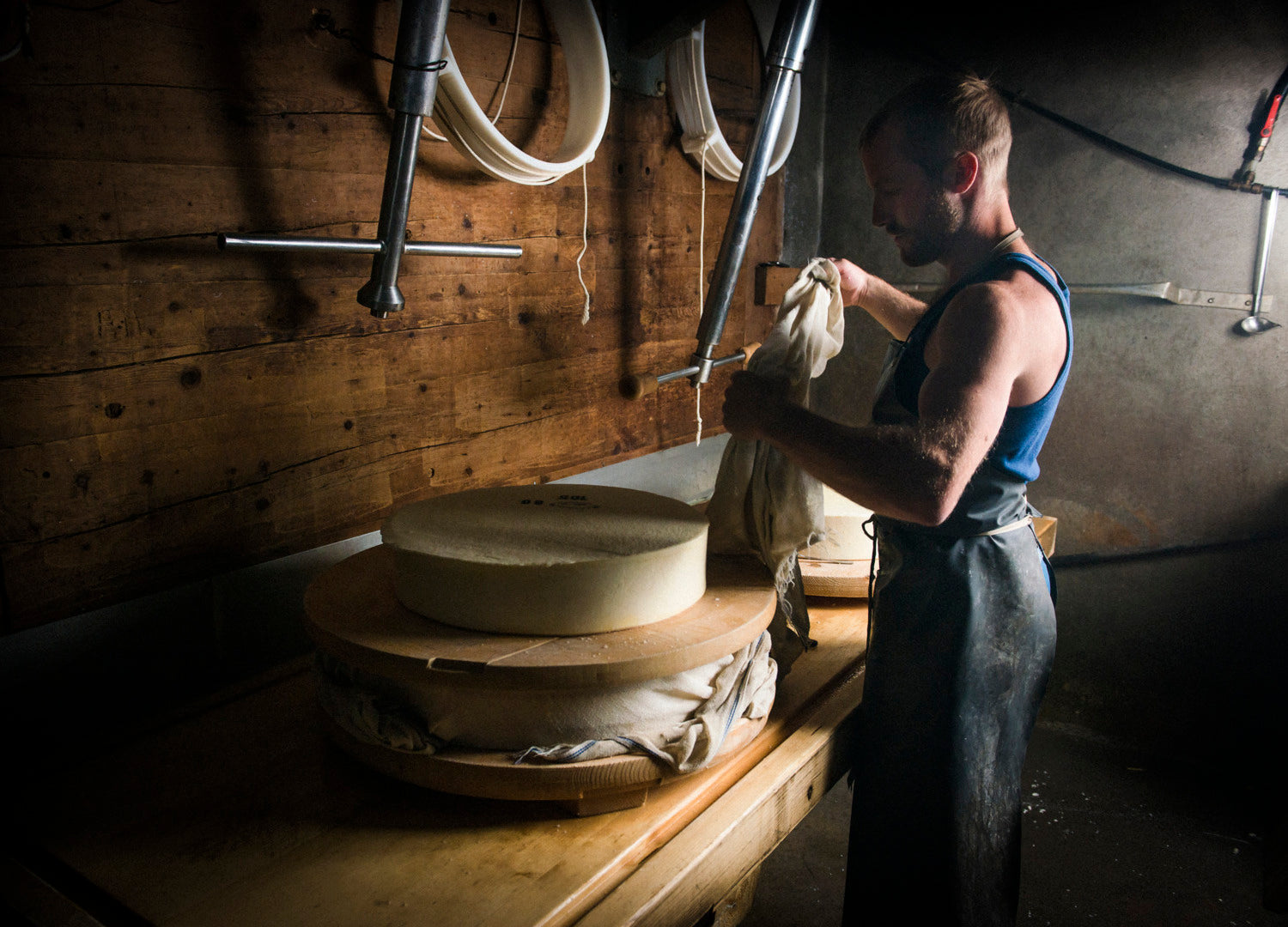
From the tray, the curd is gently lifted onto the cloths, where the first draining of the curd begins. The whey slowly flows down the chutes into a tank, from where it travels back to the farms as protein-rich animal feed, and to the nearby Ricotta cheese makers.

Gently and skillfully - cheesemakers learn how to handle the mass even weeks before they get their hands on the real cheese
Once enough whey has been extracted from the mass, the cheeses are lifted into molds. The tall cylindrical molds allow gravity to squeeze more liquid from the mass until the tall, soft mounds have condensed into discs that resemble cheese.
TEMPERATURE DETERMINES THE SOFTNESS OF THE CHEESE
Tosi mainly produces soft Gorgonzola Dolce cheese. This is made with whole milk, which gives the cheese its creaminess. The spoonable softness of the cheese is achieved by temperature: a few degrees higher temperature throughout the production process allows the cheese to maintain its luxurious softness.
Tosi makes Gorgonzola Piccante, a stronger and more slicable blue cheese, only once a month. In this case, the temperature of the entire production area, equipment, and ripening rooms must be lowered to ensure that the cheese becomes dense and intensely flavored.
WEEKLY WASHING HELPS THE CHEESE MATURATE
Blue mold is added to the cheese at the very beginning, but it is only when the cheese is perforated that the mold can develop inside the cheese. The first perforation takes place at 7 days of age; at this time, one side is perforated with a device resembling a "medieval torture device" that pokes 50 holes of different sizes and lengths into the cheese. A week later, the cheese is turned over and the other side is perforated.
Weekly washing and brushing of the cheese surface helps blue mold develop.
During the 90-day maturation period, the cheese is turned and washed with salt water every single week. The washing removes mold from the surface of the cheese and helps oxygen enter the cheese, allowing the lovely blue mold to develop.
The ripening rooms are kept at a constant, cool temperature and almost 100% humidity - imitating the climate of natural caves. Master cheesemaker and head of the Tosi cheese factory, Fabrizio Tosi, regularly tests the cheese for consistent blue mold development and proper cheese condition during ripening, ensuring the high quality of the cheeses.

Fabrizio Tosi tests the cheeses by taking a sample through the cheese. This is the last chance to influence the final outcome of the cheeses before they are sent to gourmets around the world.
Gorgonzola Dolce has a mild taste, luxuriously creamy and, as its name suggests, a little sweet - just like ice cream for adults! Serve Dolce cool as it is with pretzels, and pour a glass of dry white wine, sparkling wine, or even a summer rosé!