Graham Kirkham: the hands keeping farmhouse Lancashire alive
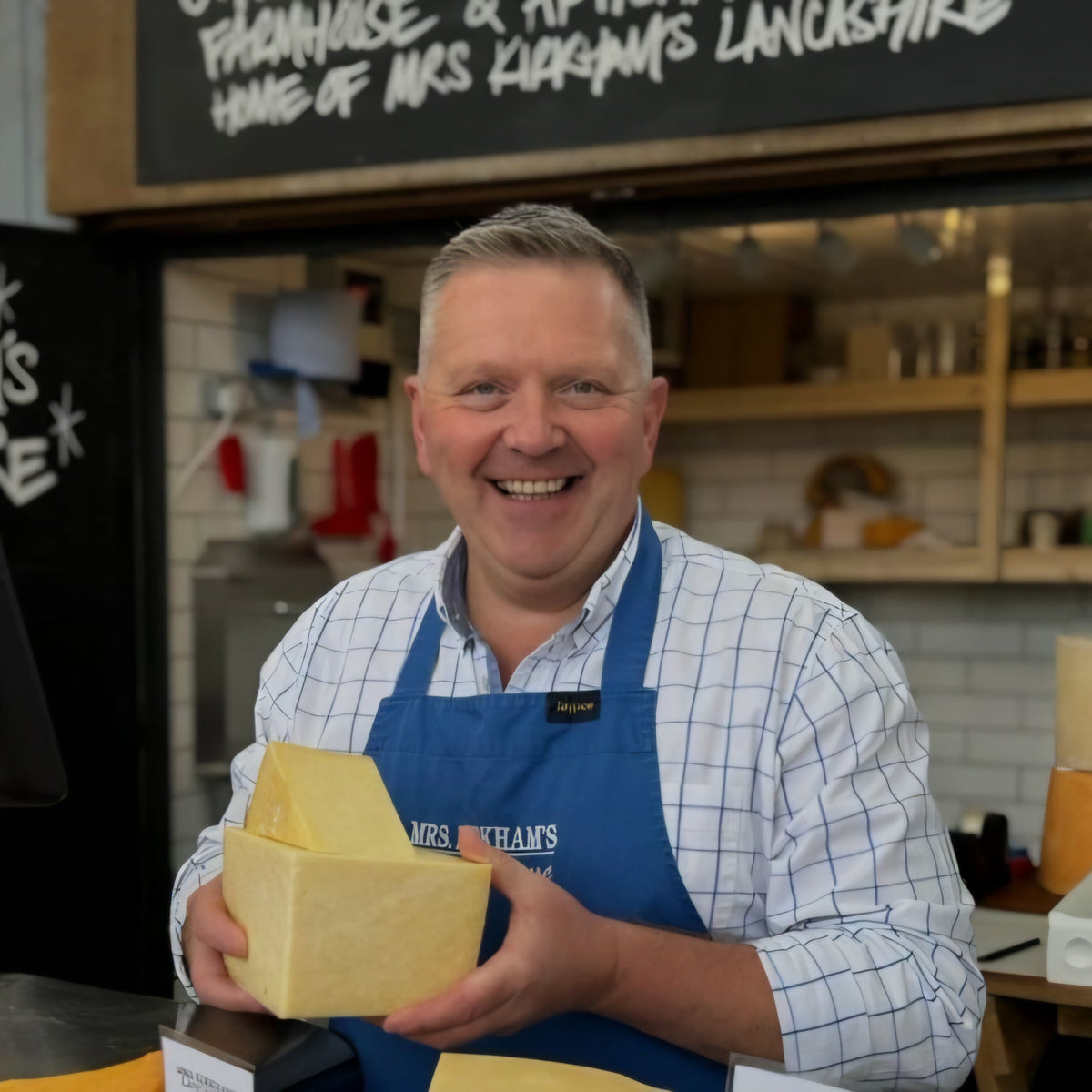
There is only one family left making traditional raw milk farmhouse Lancashire. Every morning, Graham Kirkham gets up and makes another batch.
That is quite a responsibility to carry into a dairy. But the reason we love his cheese becomes clear long before we get to its history. Break off a piece and taste it: buttery, bright and gently tangy, with a texture that crumbles, then melts into creaminess. It is remarkably light for something so rich. You find yourself reaching for another piece while still talking about the first.
This is Kirkham’s Lancashire, made at Beesley Farm in Goosnargh from the raw milk of the family’s own cows. And that extraordinary texture depends on knowledge Graham learnt beside his mother, Ruth.
What a recipe cannot tell you
Ruth was the original Mrs Kirkham. She began making cheese at Beesley Farm in 1978, after her own mother retired and passed on her equipment, recipe and knowledge. Ruth and her husband John converted an old piggery into a dairy, where she would make cheese for the next thirty years.
Graham eventually joined her there. Working beside his mother meant learning how to read the curd: how it should feel, how gently to handle it and when it was ready to move on.
These are judgements made with your hands as much as your head. A written recipe can give you temperatures and timings. Recognising how today’s milk is behaving takes practice, and knowing what to do about it takes longer still.
Graham carries that experience into each new batch. The family recipe gives him a starting point; his skill brings it to life.
Several days’ milk in one cheese
One of Lancashire’s most distinctive qualities began with a very practical problem. Small farms did not always have enough cows to make a whole cheese every day.
The solution was to make curd each day, then combine it with curds from previous days. Those curds had developed differently by the time they came together, bringing their own acidity and character to the finished cheese.
Graham still uses this method. It is slow, demanding work, but it helps create the flavour and texture that make his Lancashire so compelling.
We love this detail. You can taste the ingenuity of those small farms in a piece of cheese made today. Their way of working survives because someone still finds it worth doing.
Buttery crumble
The phrase buttery crumble sounds almost contradictory until you put a piece of Kirkham’s Lancashire in your mouth.
The cheese breaks apart easily, yet feels moist and creamy as you eat it. There is a fresh acidity beneath the butteriness that keeps the whole thing lively.
Achieving that balance takes careful cutting, stacking and draining of the curd. It needs gentle handling to preserve its structure. The work is physical, but force is of little use when what you need is sensitivity.
That attention extends back to the herd. Graham’s family sums up its approach simply: happy cows, good milk, good cheese. When he built a new dairy, completed in 2008, the investment also included a new milking parlour and better accommodation for the cows.
The girls and the cheese belong to the same undertaking. Looking after one gives him the chance to do the other well.
A very good reason to know your cheesemaker
Traditional Lancashire has lost almost all its farmhouse makers. At Beesley Farm, however, it remains part of a working day: cows to milk, curds to handle, cheeses to tend.
Buying a piece gives that work somewhere to go. So does understanding why its texture is unusual, why its flavour changes with age and why Graham takes the time to make it this way.
At our counter, we love introducing Kirkham’s Lancashire to someone who has never tasted it. Good bread and an apple make fine company for it. Crumbled over warm potatoes, it softens into something particularly lovely.
But start with a piece on its own. Let it break down slowly, notice the fresh tang beneath the butteriness, and give it a moment.
Graham has put a considerable amount of work into that mouthful.