Tim Jones and Poacher Fifty: a cheese worth waiting for
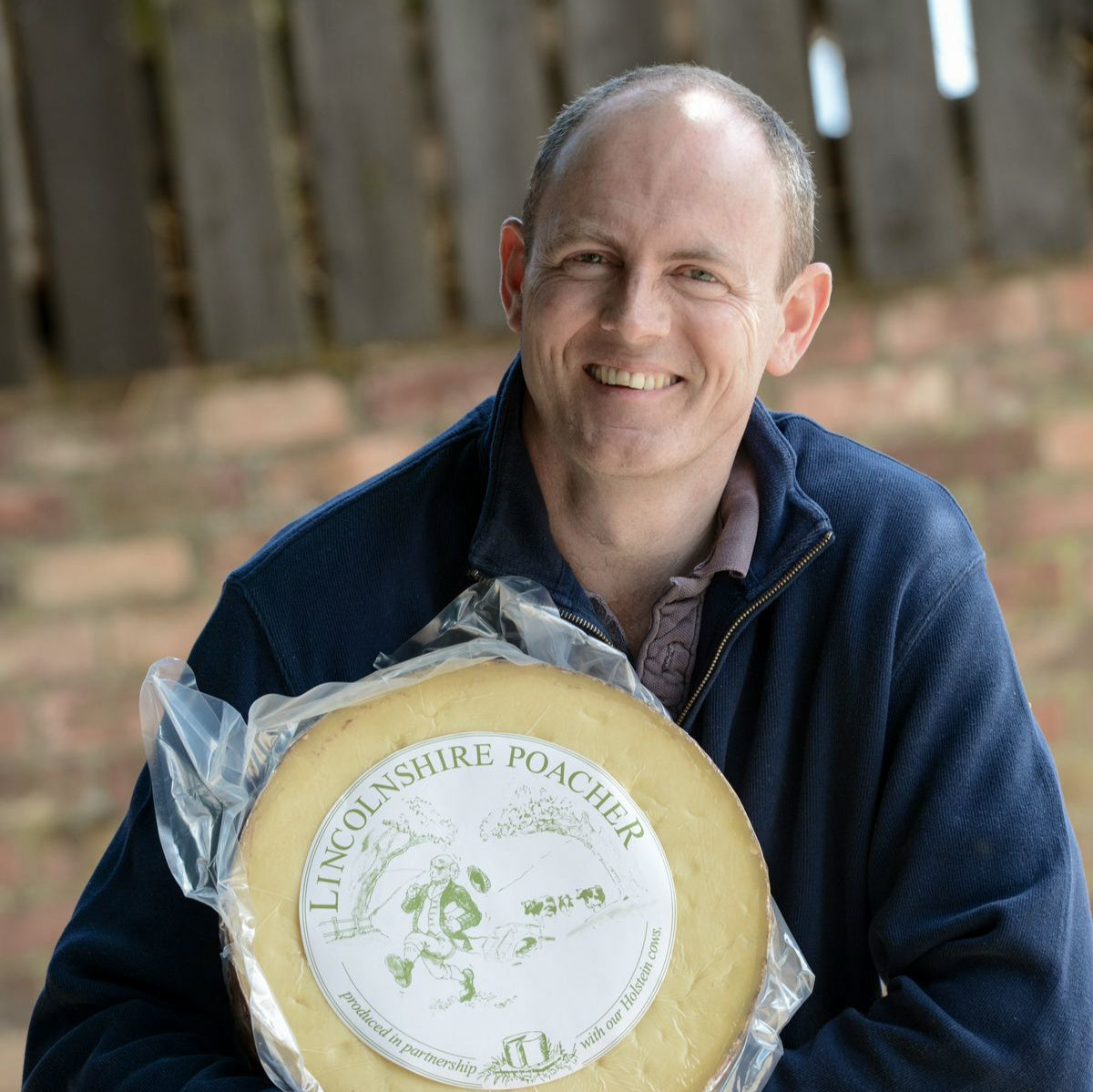
When Tim Jones’s family makes cheese, considerably more than the day’s milk goes into it. Behind each wheel are more than a century on the same farm, the care of their own herd and decades spent learning how to turn its milk into something delicious.
Tim now runs Lincolnshire Poacher with his son Sam at Ulceby Grange, on the edge of the rolling Lincolnshire Wolds. Their family has farmed here since 1917, although cheesemaking only began in 1992. Over time, it grew into a part of daily life that changed the direction of the whole farm.
The cheese we bring to our counter is Poacher Fifty. This long-aged British raw milk cheese is nutty, toasty and deeply savoury. Its story also involves a small mistake and a considerable amount of patience.
A tonic bottle and the first batch
It was Tim’s brother Simon who began making cheese after returning to the farm from agricultural college. He was interested in turning their own milk into cheese, and Welsh cheesemaker Dougal Campbell came to help. His supplies included rennet in an old tonic bottle and a sachet of starter culture.
Together, they made the first batch of Lincolnshire Poacher in February 1992. Simon continued learning from there.
The recipe brought together traditional West Country Cheddar methods and techniques associated with Alpine cheeses such as Comté. From those beginnings, the farm’s own cheese gradually took shape. It quickly found an audience: early customers at the local cheese shop were even limited in how much they could buy so that more people could have a piece.
Tim joined the business in 2000 to look after sales and marketing. Making good cheese needed to go hand in hand with finding people who would appreciate it. Over the years, turning the herd’s milk into cheese became central to the farm’s work.
Fifty degrees and a long wait
Poacher Fifty began with a batch whose curd was accidentally heated above its usual temperature, reaching 50°C.
The cheeses were finished and set aside to mature. The higher temperature had changed their texture and the way they would age, so discovering the outcome would take time. Eventually, a firmer, drier cheese emerged, with deep, toasted flavours.
The experience stayed with the team.
During the pandemic, the family faced a new problem: suddenly, there was no buyer for the farm’s surplus milk. The girls still needed milking every day. That milk needed a use, and the resulting cheese needed to be able to wait.
They returned to the higher-temperature make. It offered a way to produce cheese suited to long maturation, preserving the milk’s value at a time when selling it was difficult.
That is what we find so compelling about Fifty’s story. First came the judgement to recognise that an unexpected batch was worth keeping. Later came the experience to put that knowledge to use.
The farm’s work, expressed in cheese
For Tim, the cheese represents the whole farm and the work that happens there. Farming, animal care and cheesemaking are closely connected.
The milk comes from their own herd. Much of the girls’ feed is grown on the farm, giving the family influence over quality from the fields onwards. The grass and other crops they eat affect the milk’s composition and how it behaves in the dairy. Good animal care and careful milk handling give the cheesemakers a sound foundation to build on.
The farm also produces energy. Wind and solar power generate electricity, while pellets made from their own straw help heat the milk. Clover supplies nitrogen to the soil, and hedges are cut less frequently to provide food and shelter for wildlife.
Each decision helps shape the farm that passes to the next generation. Sam is now building that future alongside his father.
Poacher Fifty at our cheese counter
Long maturation gives Poacher Fifty time to develop its powerful, layered flavour. There is toastiness, nuttiness and savoury depth, alongside a caramel sweetness. It reminds us of some of our favourite qualities in Cheddar, Comté and aged Gouda, while having a character entirely its own.
The firm cheese breaks into small, irregular pieces. Let a piece warm up a little before tasting: there is plenty to discover, and the flavour lingers well beyond the first bite.
Fifty deserves a place in the kitchen too. Fine shavings soften over warm risotto, while a little grated cheese brings considerable flavour to pasta or roasted vegetables.
With a cheese like this, you find yourself thinking about the distance between the morning’s milk and the finished piece on your plate. For Poacher Fifty, that journey holds years of maturation, a family’s work and a decision to give an unexpected result its chance.